Description
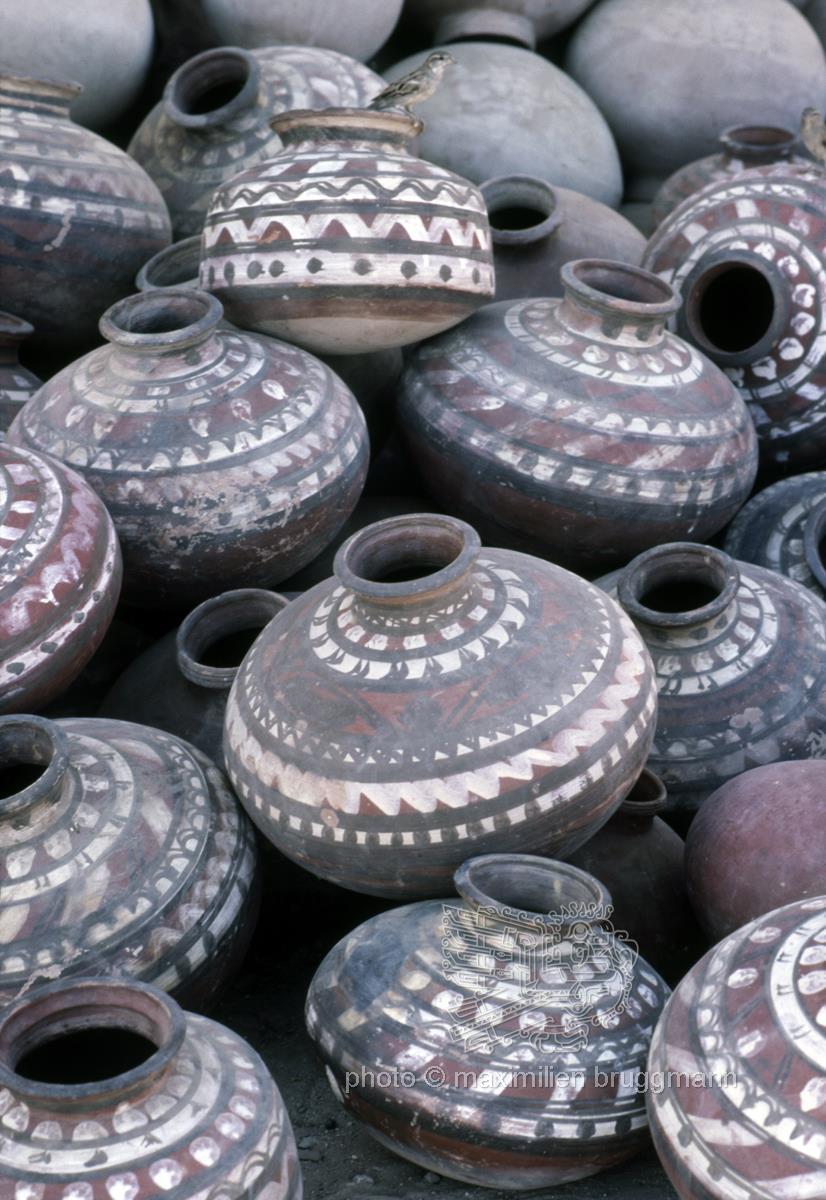
A large collection of hand-painted clay water pots, known as matkas in Indian culture. Matkas utilise the principle of evaporative cooling. Through the microscopic pores of the unglazed clay, a minimal amount of water seeps out and evaporates, keeping the remaining water inside pleasantly cool even in intense heat. The pots are decorated with characteristic patterns. These include geometric shapes such as zigzag lines, waves, dots and bands of lines, usually applied in white, black and reddish earth tones. The production of these vessels is a craft dating back thousands of years, passed down from generation to generation. Each pot is shaped on the potter’s wheel and then artistically painted by hand. – Jaisalmer – 1990
Description
A large collection of hand-painted clay water pots, known as matkas in Indian culture. Matkas utilise the principle of evaporative cooling. Through the microscopic pores of the unglazed clay, a minimal amount of water seeps out and evaporates, keeping the remaining water inside pleasantly cool even in intense heat. The pots are decorated with characteristic patterns. These include geometric shapes such as zigzag lines, waves, dots and bands of lines, usually applied in white, black and reddish earth tones. The production of these vessels is a craft dating back thousands of years, passed down from generation to generation. Each pot is shaped on the potter’s wheel and then artistically painted by hand. – Jaisalmer – 1990