Description
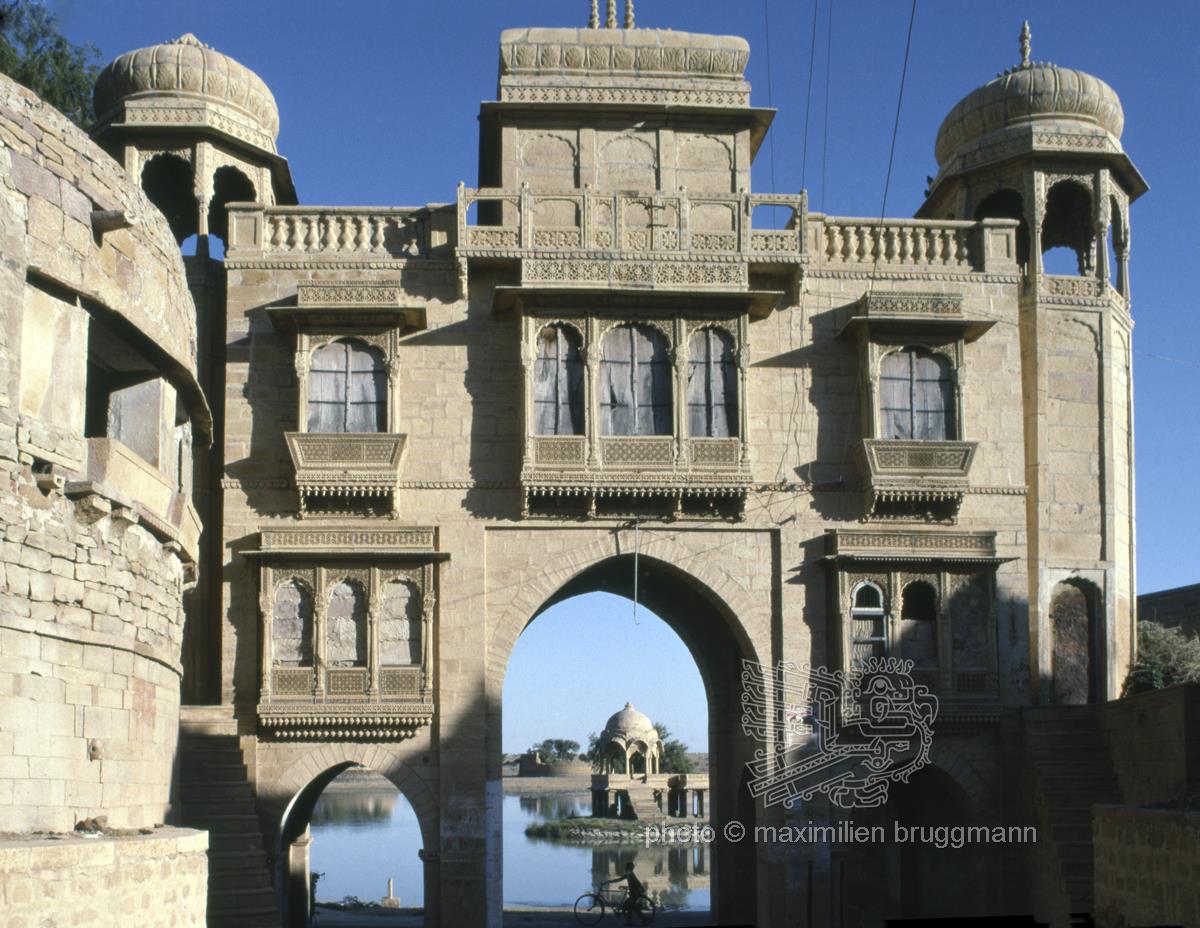
The building depicts the magnificent Tilon Ki Pol gateway leading to the artificial Gadisar Lake in the desert city of Jaisalmer in Rajasthan. Constructed from the region’s characteristic golden-yellow sandstone, this two-storey gateway has one of the most fascinating histories. It was commissioned in the 14th century by a wealthy and famous royal courtesan named Tilon. The then ruler (Maharawal) of Jaisalmer initially rejected the structure. As he used the lake regularly, he felt it was beneath his dignity to pass under a gate financed by a courtesan. He threatened to have the gate demolished. Whilst the king was away on a journey, Tilon had the gate completed without further ado. To permanently prevent the threatened demolition, she placed a statue of the god Vishnu (often described as a Krishna temple) atop the gate. As the building was thus regarded as a sacred site, the king was no longer permitted to destroy it. The gate is notable for its classic Rajput architectural style: the jharokhas are delicate, stone-carved, balcony-like bay windows typical of the architecture in Jaisalmer. Two striking pavilions (chattris) crown the outer corners of the gate. Through the large main arch of the gate, one looks directly out onto the calm waters of Gadisar Lake and the small shrines built within the lake. - 1990
Description
The building depicts the magnificent Tilon Ki Pol gateway leading to the artificial Gadisar Lake in the desert city of Jaisalmer in Rajasthan. Constructed from the region’s characteristic golden-yellow sandstone, this two-storey gateway has one of the most fascinating histories. It was commissioned in the 14th century by a wealthy and famous royal courtesan named Tilon. The then ruler (Maharawal) of Jaisalmer initially rejected the structure. As he used the lake regularly, he felt it was beneath his dignity to pass under a gate financed by a courtesan. He threatened to have the gate demolished. Whilst the king was away on a journey, Tilon had the gate completed without further ado. To permanently prevent the threatened demolition, she placed a statue of the god Vishnu (often described as a Krishna temple) atop the gate. As the building was thus regarded as a sacred site, the king was no longer permitted to destroy it. The gate is notable for its classic Rajput architectural style: the jharokhas are delicate, stone-carved, balcony-like bay windows typical of the architecture in Jaisalmer. Two striking pavilions (chattris) crown the outer corners of the gate. Through the large main arch of the gate, one looks directly out onto the calm waters of Gadisar Lake and the small shrines built within the lake. - 1990