logo
  • Home
  • His life ...
    • Biography
    • Curriculum Vitae
    • Book: “Maximilien au Désert” NEW !
  • His work ...
    • Books
    • Expos
    • Painting
    • Embossings
    • New Year's wishesNEW !
    • Online ExhibitionsNEW !
    • Slideshows
  • Media ...
    • Documentation
    • Videos
    • Contact
  • Photo Gallery ...
    • All Photos
    • -
    • Sahara Rock Art completed
    • Tuareg
    • Pueblos
    • Northwest Indians
    • Peru
    • The culture of the Incas
    • Pre-Inca cultures
    • The Andes
    • Argentina
    • Gauchos
    • Central America
    • Sahara 1962-1975
    • Sahel
    • Sahara : Tassili - Tadrart 1993
    • From the Ténéré to the Aïr Mountains
    • In the dunes of Erg Izane
    • Across the Tamgak Mountains
    • From Adrar Bous into the Tamgak Mountains
    • With the Tuareg on the edge of the Tamgak Mountains
    • Building a Tataram: Documentation
    • The Spice Route – Spices NEW !
    • The Spice Route – Java and Sulawesi NEW !
    • The Spice Route – Moluccas NEW !
    • The Spice Route – Malaysia, Singapore and Sri Lanka NEW !
    • The Spice Route – India : Kerala, Goa and Mumbai NEW !
    • The Spice Route – India: Rajasthan NEW !
    • The Spice Route – Africa – Europe NEW !
  • Comments
    flag flag flag flag    

Description

  • Foto Number: 42N-281-28

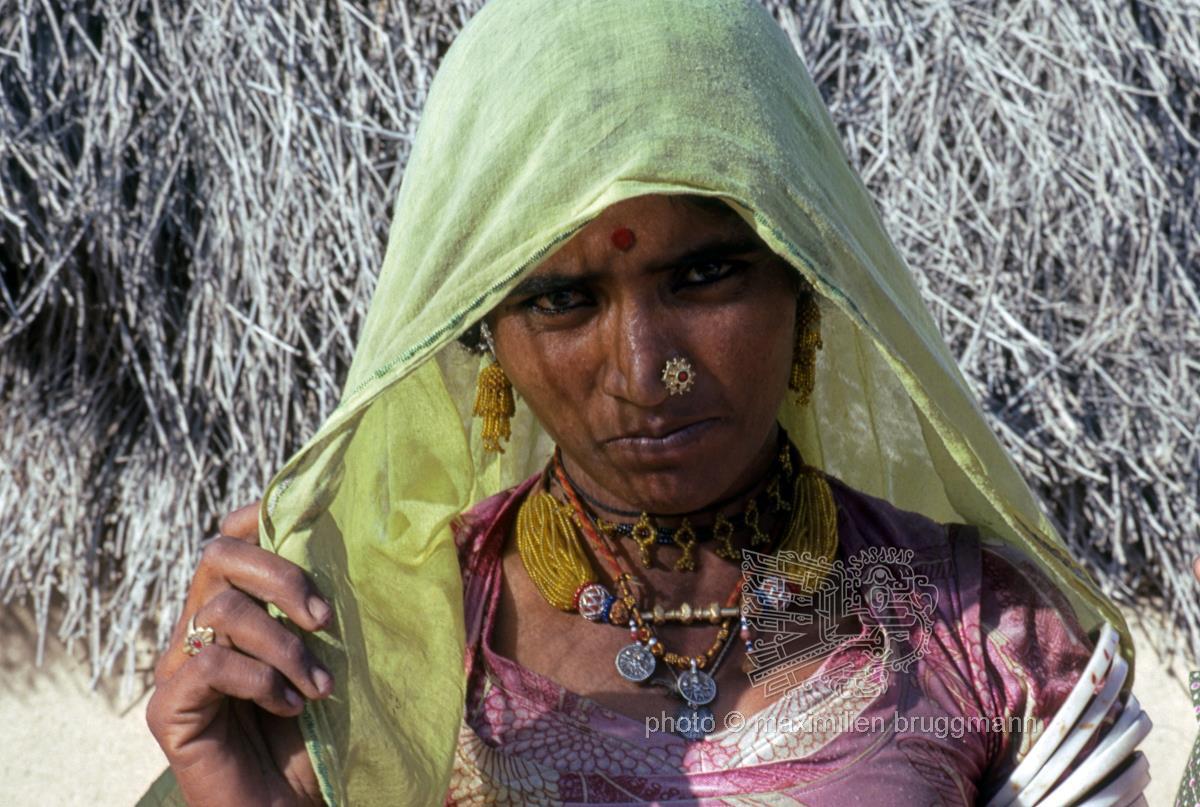
A woman from Khuri in Rajasthan. Her appearance is deeply rooted in the traditions of the local nomadic or semi-nomadic tribes. The yellow-green headscarf (odhani) protects her from the intense desert sun and is an essential part of the traditional women’s costume. The golden nose ring (nath) with small decorations is a classic feature of married women in rural areas of Rajasthan. She wears heavy, layered necklaces, including yellow pearl necklaces and silver amulets, which often serve as protective symbols. On her arms are the characteristic white bangles, traditionally made of ivory (nowadays mostly plastic). The red dot on her forehead has spiritual significance and often symbolises the ‘third eye’ or her married status. – 1990
  • Keywords:
    Asia India Rajasthan Khuri woman jewelry bracelet nose ring veil Sari Bindi Spice Route-F Spice Route

Description

  • Foto Number: 42N-281-28

A woman from Khuri in Rajasthan. Her appearance is deeply rooted in the traditions of the local nomadic or semi-nomadic tribes. The yellow-green headscarf (odhani) protects her from the intense desert sun and is an essential part of the traditional women’s costume. The golden nose ring (nath) with small decorations is a classic feature of married women in rural areas of Rajasthan. She wears heavy, layered necklaces, including yellow pearl necklaces and silver amulets, which often serve as protective symbols. On her arms are the characteristic white bangles, traditionally made of ivory (nowadays mostly plastic). The red dot on her forehead has spiritual significance and often symbolises the ‘third eye’ or her married status. – 1990

  • Keywords:
    Asia India Rajasthan Khuri woman jewelry bracelet nose ring veil Sari Bindi Spice Route-F Spice Route

Website © 2026 pb + StratLabs
Copyright © Estate of Maximilien Bruggmann for all photos. Any use for commercial purposes prohibited.
flag flag flag flag