Description
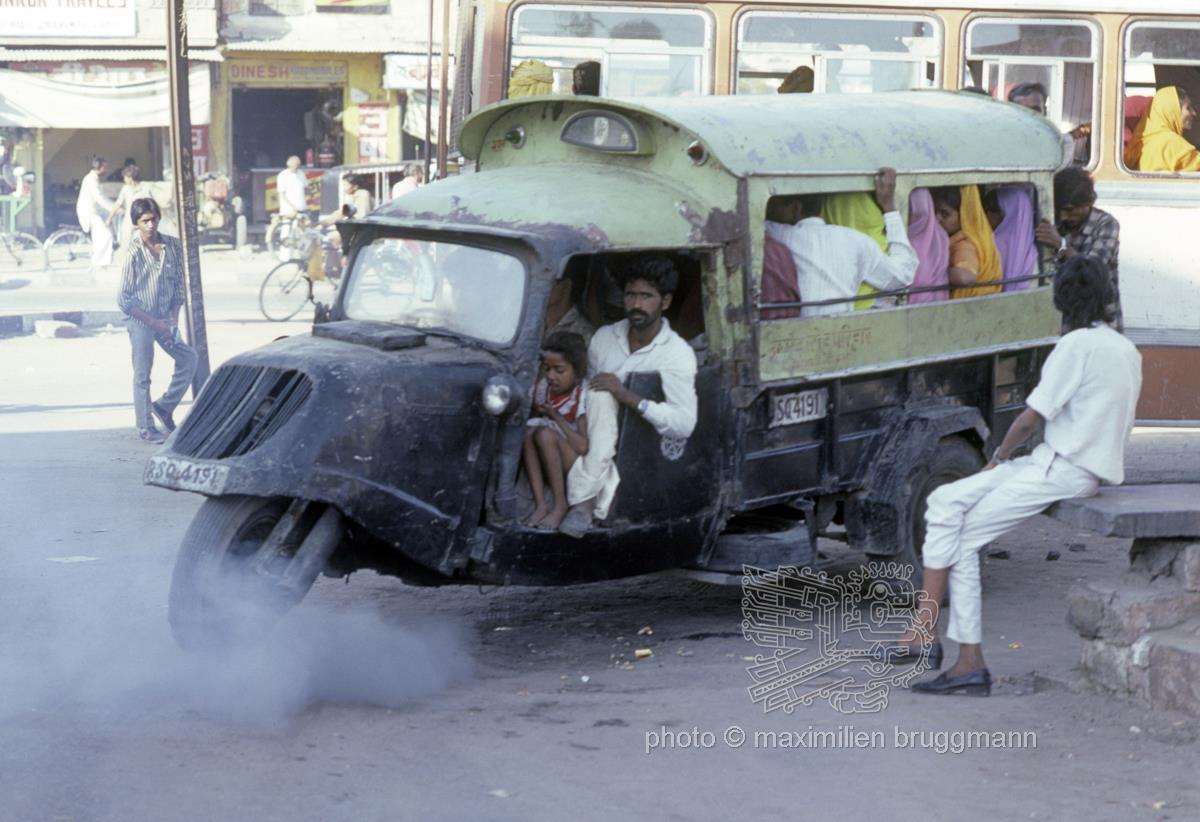
This three-wheeled vehicle is a Tempo Hanseat, an iconic mode of transport that has been a familiar sight on Indian roads for decades. The vehicle was originally developed in the 1940s and 1950s by the German company Vidal & Sohn Tempo-Werke in Hamburg-Harburg. In 1958, the Indian company Firodia Ltd (later known as Bajaj Tempo and now Force Motors) entered into a partnership with Tempo-Werke. Production of the Hanseat continued under licence in India until the year 2000. Although it was designed as a light goods vehicle, owners frequently converted it. Fitted with bench seats and a canopy, it served as a shared taxi for large numbers of passengers in many regions of India – particularly in rural areas.
The vehicle featured a distinctive front-wheel drive layout, with the engine positioned directly above the single front wheel. Legendary features included the extremely loud, rattling engine noise, starting the engine via a pull-cord under the bonnet, and the angled rear wheels, which only straightened up under heavy loads. – Jodhpur – 1990
Description
This three-wheeled vehicle is a Tempo Hanseat, an iconic mode of transport that has been a familiar sight on Indian roads for decades. The vehicle was originally developed in the 1940s and 1950s by the German company Vidal & Sohn Tempo-Werke in Hamburg-Harburg. In 1958, the Indian company Firodia Ltd (later known as Bajaj Tempo and now Force Motors) entered into a partnership with Tempo-Werke. Production of the Hanseat continued under licence in India until the year 2000. Although it was designed as a light goods vehicle, owners frequently converted it. Fitted with bench seats and a canopy, it served as a shared taxi for large numbers of passengers in many regions of India – particularly in rural areas.
The vehicle featured a distinctive front-wheel drive layout, with the engine positioned directly above the single front wheel. Legendary features included the extremely loud, rattling engine noise, starting the engine via a pull-cord under the bonnet, and the angled rear wheels, which only straightened up under heavy loads. – Jodhpur – 1990