logo
  • Home
  • His life ...
    • Biography
    • Curriculum Vitae
    • Book: “Maximilien au Désert” NEW !
  • His work ...
    • Books
    • Expos
    • Painting
    • Embossings
    • New Year's wishesNEW !
    • Online ExhibitionsNEW !
    • Slideshows
  • Media ...
    • Documentation
    • Videos
    • Contact
  • Photo Gallery ...
    • All Photos
    • -
    • Sahara Rock Art completed
    • Tuareg
    • Pueblos
    • Northwest Indians
    • Peru
    • The culture of the Incas
    • Pre-Inca cultures
    • The Andes
    • Argentina
    • Gauchos
    • Central America
    • Sahara 1962-1975
    • Sahel
    • Sahara : Tassili - Tadrart 1993
    • From the Ténéré to the Aïr Mountains
    • In the dunes of Erg Izane
    • Across the Tamgak Mountains
    • From Adrar Bous into the Tamgak Mountains
    • With the Tuareg on the edge of the Tamgak Mountains
    • Building a Tataram: Documentation
    • The Spice Route – Spices NEW !
    • The Spice Route – Java and Sulawesi NEW !
    • The Spice Route – Moluccas NEW !
    • The Spice Route – Malaysia, Singapore and Sri Lanka NEW !
    • The Spice Route – India : Kerala, Goa and Mumbai NEW !
    • The Spice Route – India: Rajasthan NEW !
    • The Spice Route – Africa – Europe NEW !
  • Comments
    flag flag flag flag    

Description

  • Foto Number: 42N-311-33

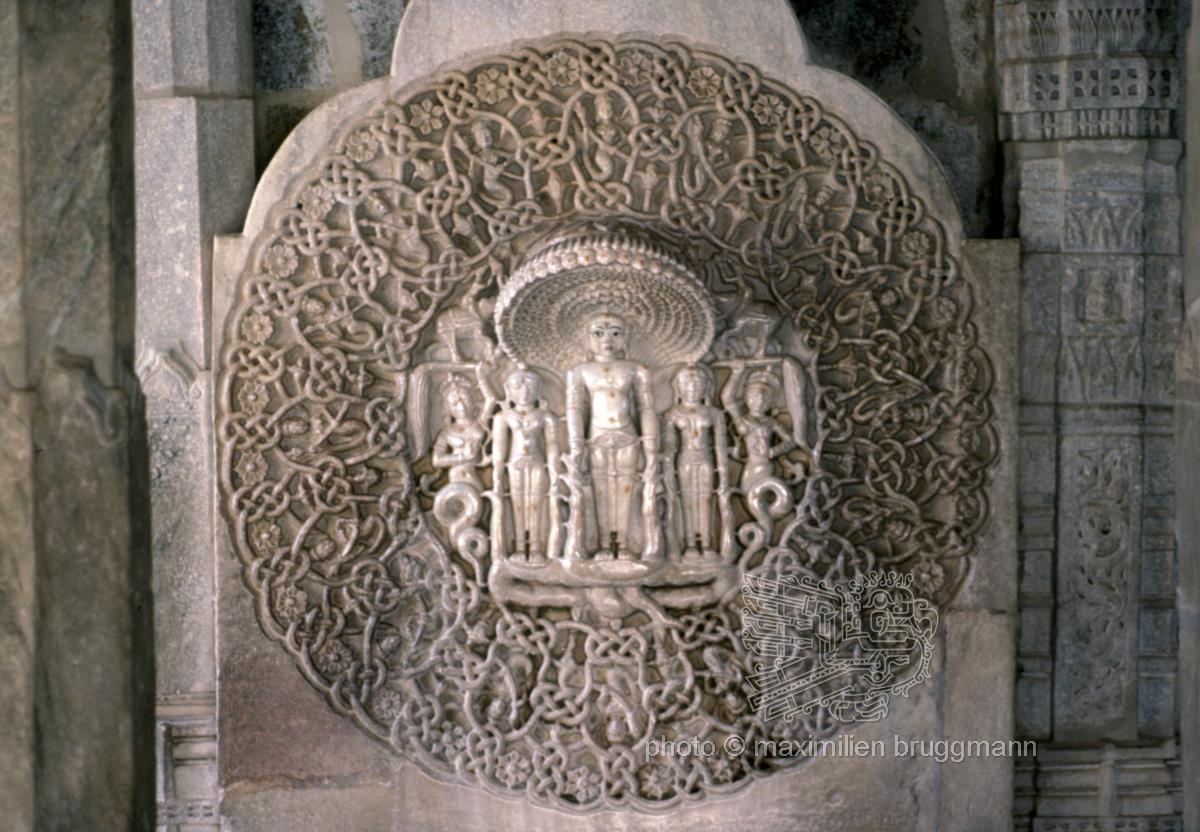
An extraordinary marble carving from the Ranakpur Jain Temple (also known as the Chaumukha Temple) in Rajasthan, India. It depicts Parshvanatha, the 23rd Tirthankara (spiritual teacher) of the Jain religion. A characteristic feature of Parshvanatha is the canopy of snake heads above his head. This particular carving is often referred to as Nagdaman. The sculpture is famous for its complexity: it depicts Parshvanatha surrounded by a dense network of 1,008 intertwined snakes. The snakes’ tails are so artfully interwoven that it is almost impossible to find their beginning or end. The temple was built in the 15th century and is considered one of the most significant masterpieces of Jain architecture. It is best known for its 1,444 individually carved marble pillars, none of which are alike. – 1990
  • Keywords:
    Asia India Rajasthan sculpture temple Ranakpur Spice Route-F Spice Route

Description

  • Foto Number: 42N-311-33

An extraordinary marble carving from the Ranakpur Jain Temple (also known as the Chaumukha Temple) in Rajasthan, India. It depicts Parshvanatha, the 23rd Tirthankara (spiritual teacher) of the Jain religion. A characteristic feature of Parshvanatha is the canopy of snake heads above his head. This particular carving is often referred to as Nagdaman. The sculpture is famous for its complexity: it depicts Parshvanatha surrounded by a dense network of 1,008 intertwined snakes. The snakes’ tails are so artfully interwoven that it is almost impossible to find their beginning or end. The temple was built in the 15th century and is considered one of the most significant masterpieces of Jain architecture. It is best known for its 1,444 individually carved marble pillars, none of which are alike. – 1990

  • Keywords:
    Asia India Rajasthan sculpture temple Ranakpur Spice Route-F Spice Route

Website © 2026 pb + StratLabs
Copyright © Estate of Maximilien Bruggmann for all photos. Any use for commercial purposes prohibited.
flag flag flag flag