logo
  • Home
  • His life ...
    • Biography
    • Curriculum Vitae
    • Book: “Maximilien au Désert” NEW !
  • His work ...
    • Books
    • Expos
    • Painting
    • Embossings
    • New Year's wishesNEW !
    • Online ExhibitionsNEW !
    • Slideshows
  • Media ...
    • Documentation
    • Videos
    • Contact
  • Photo Gallery ...
    • All Photos
    • -
    • Sahara Rock Art completed
    • Tuareg
    • Pueblos
    • Northwest Indians
    • Peru
    • The culture of the Incas
    • Pre-Inca cultures
    • The Andes
    • Argentina
    • Gauchos
    • Central America
    • Sahara 1962-1975
    • Sahel
    • Sahara : Tassili - Tadrart 1993
    • From the Ténéré to the Aïr Mountains
    • In the dunes of Erg Izane
    • Across the Tamgak Mountains
    • From Adrar Bous into the Tamgak Mountains
    • With the Tuareg on the edge of the Tamgak Mountains
    • Building a Tataram: Documentation
    • The Spice Route – Spices NEW !
    • The Spice Route – Java and Sulawesi NEW !
    • The Spice Route – Moluccas NEW !
    • The Spice Route – Malaysia, Singapore and Sri Lanka NEW !
    • The Spice Route – India : Kerala, Goa and Mumbai NEW !
    • The Spice Route – India: Rajasthan NEW !
    • The Spice Route – Africa – Europe NEW !
  • Comments
    flag flag flag flag    

Description

  • Foto Number: 42N-239-35

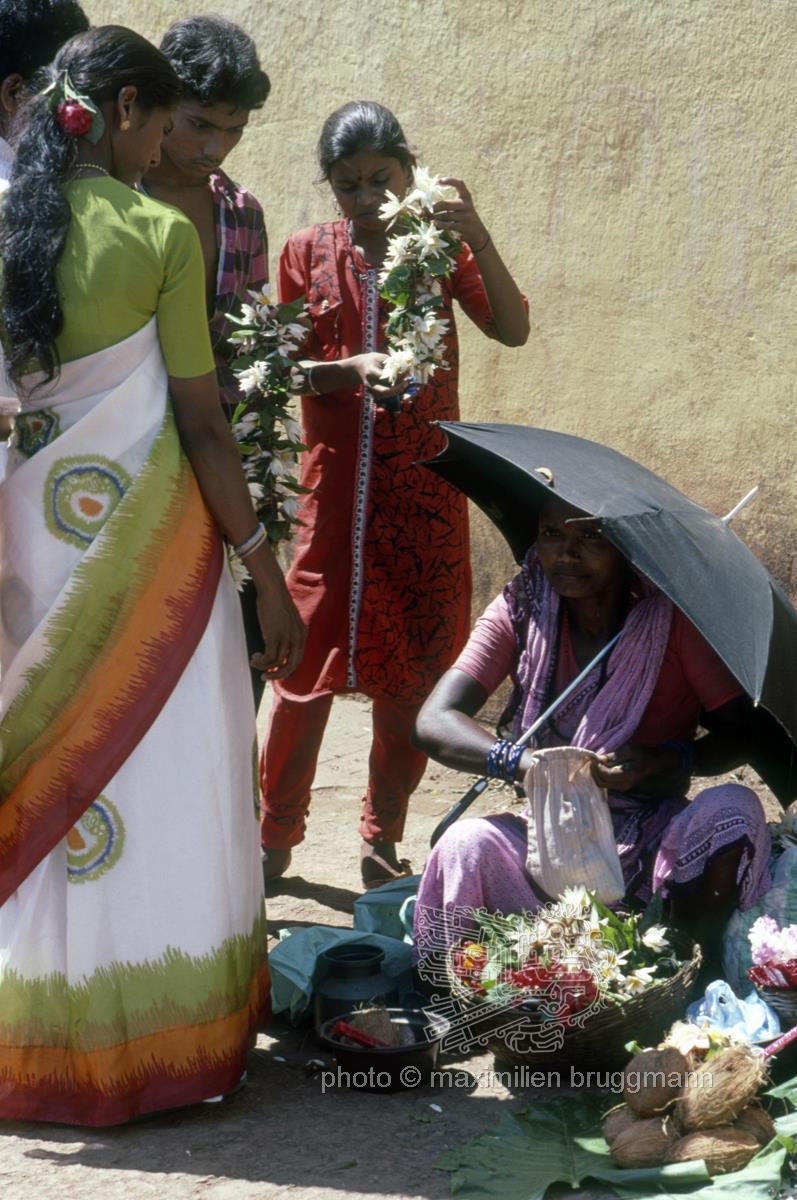
A flower seller outside the Sri Manguesh Temple (also known as Shree Mangeshi Temple), located in the village of Mangeshi in Goa, about 21 km from Panaji. It is one of the most significant and most visited Hindu temples in the region. Pilgrims often buy coconuts, flowers or garlands before entering the temple. In Hindu tradition, the coconut is regarded as an ‘auspicious fruit’. Smashing the hard shell symbolises shedding the ego in order to reach the pure core within. The flowers and garlands are offered to the deity (an incarnation of Lord Shiva). The gentle laying of the flowers at the feet of the deity symbolises, ritually, the letting go of worldly desires. – 1990
  • Keywords:
    Asia India Goa woman flowers Parasol coconut temple Sari Spice Route-E Spice Route

Description

  • Foto Number: 42N-239-35

A flower seller outside the Sri Manguesh Temple (also known as Shree Mangeshi Temple), located in the village of Mangeshi in Goa, about 21 km from Panaji. It is one of the most significant and most visited Hindu temples in the region. Pilgrims often buy coconuts, flowers or garlands before entering the temple. In Hindu tradition, the coconut is regarded as an ‘auspicious fruit’. Smashing the hard shell symbolises shedding the ego in order to reach the pure core within. The flowers and garlands are offered to the deity (an incarnation of Lord Shiva). The gentle laying of the flowers at the feet of the deity symbolises, ritually, the letting go of worldly desires. – 1990

  • Keywords:
    Asia India Goa woman flowers Parasol coconut temple Sari Spice Route-E Spice Route

Website © 2026 pb + StratLabs
Copyright © Estate of Maximilien Bruggmann for all photos. Any use for commercial purposes prohibited.
flag flag flag flag