Description
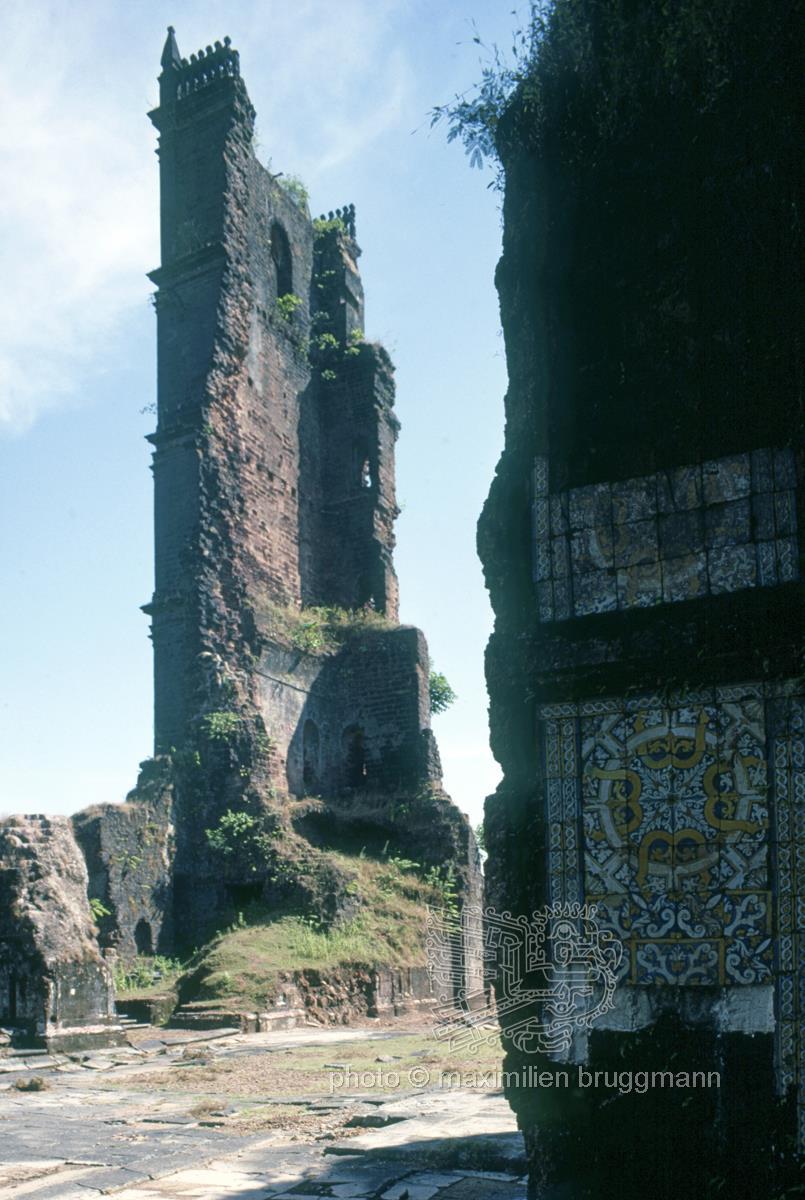
The picture shows St Augustine’s Tower in Old Goa, India. It is the most striking remnant of the once magnificent church and monastery of St Augustine. The church was completed between 1572 and 1602 by Augustinian monks. It was once one of the largest churches in Goa and indeed in the whole of Asia. Following the Portuguese government’s ban on religious orders in 1835, the monastery was abandoned and fell into disrepair. The façade and half of the tower collapsed in 1931, followed by further sections in 1938. Of the original four towers, only this single bell tower, approximately 46 metres high, remains today. The ruins form part of the UNESCO World Heritage Site ‘Churches and Monasteries of Goa’.
On the right-hand side of the picture, decorated tiles (azulejos) can be seen on the remaining sections of the walls. These ornamental tiles are typical of Portuguese architecture of that period and bear witness to the former splendour of the interior. – 1990
Description
The picture shows St Augustine’s Tower in Old Goa, India. It is the most striking remnant of the once magnificent church and monastery of St Augustine. The church was completed between 1572 and 1602 by Augustinian monks. It was once one of the largest churches in Goa and indeed in the whole of Asia. Following the Portuguese government’s ban on religious orders in 1835, the monastery was abandoned and fell into disrepair. The façade and half of the tower collapsed in 1931, followed by further sections in 1938. Of the original four towers, only this single bell tower, approximately 46 metres high, remains today. The ruins form part of the UNESCO World Heritage Site ‘Churches and Monasteries of Goa’.
On the right-hand side of the picture, decorated tiles (azulejos) can be seen on the remaining sections of the walls. These ornamental tiles are typical of Portuguese architecture of that period and bear witness to the former splendour of the interior. – 1990