Description
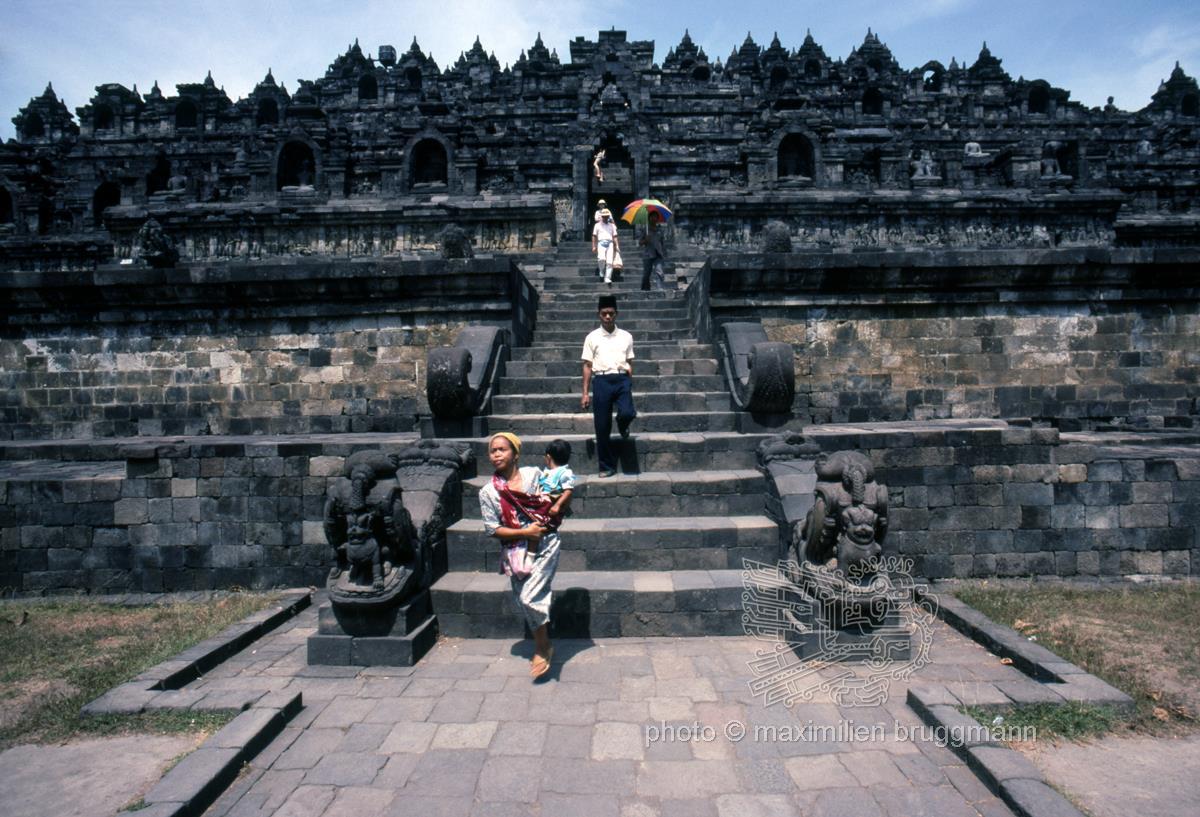
The Borobudur temple is believed to have been built between 778 and 856, but like the rest of Central Java, it was abandoned just a hundred years after its completion and buried under a mountain of ash for a thousand years following an eruption of the neighbouring Merapi volcano. In 1814, under the English Vice-Governor Thomas Stamford Raffles, the history of the rediscovery of this temple complex began. Borobudur has the shape of a square step pyramid with a base length of 113 metres. Four monumental staircases, aligned with the four points of the compass, lead to the top. Seen from above, the temple is a mandala, an aid to meditation, and as a whole, a stupa or three-dimensional model of the cosmos. The walls of the lower terraces are covered with bas-reliefs depicting the life of Gautama Buddha and his disciples, while the upper steps remain without pictorial decoration. Instead, numerous smaller stupas rise here, towered over by the main stupa, which culminates at a height of thirty-five metres. – 1990
Description
The Borobudur temple is believed to have been built between 778 and 856, but like the rest of Central Java, it was abandoned just a hundred years after its completion and buried under a mountain of ash for a thousand years following an eruption of the neighbouring Merapi volcano. In 1814, under the English Vice-Governor Thomas Stamford Raffles, the history of the rediscovery of this temple complex began. Borobudur has the shape of a square step pyramid with a base length of 113 metres. Four monumental staircases, aligned with the four points of the compass, lead to the top. Seen from above, the temple is a mandala, an aid to meditation, and as a whole, a stupa or three-dimensional model of the cosmos. The walls of the lower terraces are covered with bas-reliefs depicting the life of Gautama Buddha and his disciples, while the upper steps remain without pictorial decoration. Instead, numerous smaller stupas rise here, towered over by the main stupa, which culminates at a height of thirty-five metres. – 1990